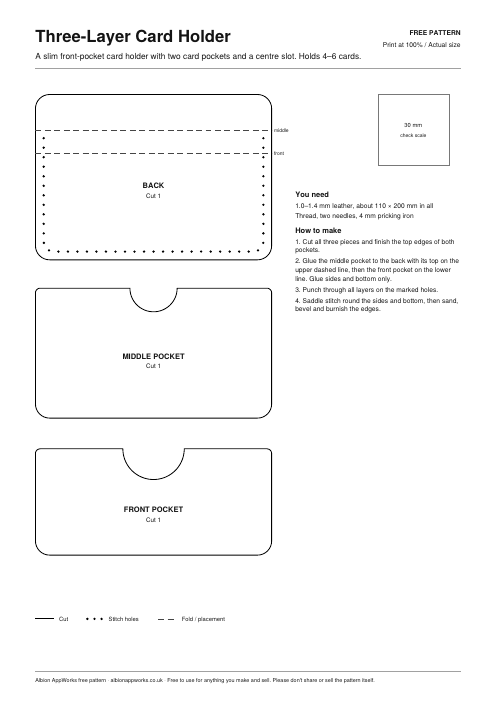
A card holder is the classic first “proper” leather project. It is small enough to make in an evening, it teaches you stitching and edge finishing, and you will actually use it. This guide walks through our free three-layer card holder, which has two card pockets and a slot in the middle.
Download the free pattern here and print it at actual size before you start.
What you need
- Leather, 1.0 to 1.4 mm thick, about 110 × 200 mm in total
- A sharp knife, cutting mat and steel rule
- A 4 mm pricking iron and mallet (or an awl)
- Two harness needles and waxed thread, about four times the stitch length
- Contact cement or leather glue
- An edge beveller, sandpaper and burnishing gum or water
1. Cut the pieces
Glue the printed pattern to card and cut out the three templates: the back, the middle pocket and the front pocket. Trace round them on the grain side of the leather and cut with a fresh blade. Take your time on the thumb notches; a smooth curve looks far better than a fast one.
2. Finish the pocket tops first
The top edges of both pockets will not be stitched, and once the holder is glued up you cannot reach them properly. Bevel, sand and burnish those edges now while each piece is flat.
3. Glue up
The back piece has two dashed lines near the top. Glue the middle pocket so its top edge sits on the upper line, then the front pocket on the lower line. Only glue the sides and bottom, about 4 mm in from the edge, or you will glue your pockets shut.
4. Punch and stitch
Punch through all three layers along the stitch holes marked on the back piece. Saddle stitch from one top corner, round the bottom and up to the other, then backstitch two holes to lock it. Keep the same tension on every stitch and the line will look even.
Start and finish your stitching on the back of the holder, where the backstitch is least noticeable.
5. Finish the edges
Sand the outside edges until all three layers are flush, bevel both sides, then burnish until they shine. A drop of water or burnishing gum helps on most leathers. That is it: a card holder that will last for years.
Making more than one?
If you are making these to sell, it is worth knowing exactly what each one costs you. Stock & Costing tracks your leather and thread, works out the cost of each piece including your time, and suggests a price that still pays you after Etsy or Shopify fees. And if you cut on a laser, Laser-Ready DXF will turn this pattern into a cut file.